Dietary requirements and allergens in catering
A caterer must always be able to inform you about fourteen allergens. That is not a courtesy, it is the law. Alongside that sits everything that is not an allergy but still counts: vegetarian, vegan, halal, something someone simply does not like. Here is how those two differ, and how best to pass them on.
What must a caterer tell you by law?
A food business must always be able to give information about fourteen allergens on an EU list, and that applies to prepacked products and non-prepacked food alike. Catering falls under it: the absence of a label on a canapé excuses no kitchen from anything.
The fourteen are: gluten-containing cereals, crustaceans, eggs, fish, peanuts, soy, milk, tree nuts, celery, mustard, sesame seeds, sulphur dioxide and sulphites, lupin and molluscs. The Dutch food authority, the NVWA, enforces this.
In practice this means you may always ask, and that a good answer is specific. "I don't think there are any nuts in that" is not an answer.
What is the difference between an allergy and a dietary preference?
An allergy is a risk; a dietary preference is a choice. That sounds blunt, but the difference decides how a kitchen handles it: an allergy is about cross-contamination, separate boards and certainty, while a preference is about an equal alternative that tastes as good as the rest.
So pass them on separately, and as concretely as you can. "Two vegetarians and one nut allergy" is usable. "A few people don't eat meat and there's something with nuts" is not.
When should you pass dietary requirements on?
With the enquiry, even if you do not know them all yet. We build them into the proposal rather than improvising a solution in the week of the event, which saves improvisation, and improvisation is exactly what you do not want around an allergy.
If more come in later, that is no problem; guest lists always shift. The point is that the menu is built around them rather than something being invented around it afterwards.
How do you avoid someone eating apart from everyone else?
By making the alternative part of the menu instead of an exception to it. No two events are the same and neither are two groups of guests; we agree every dietary requirement and allergy with you in advance, so everyone can enjoy the evening without a second thought.
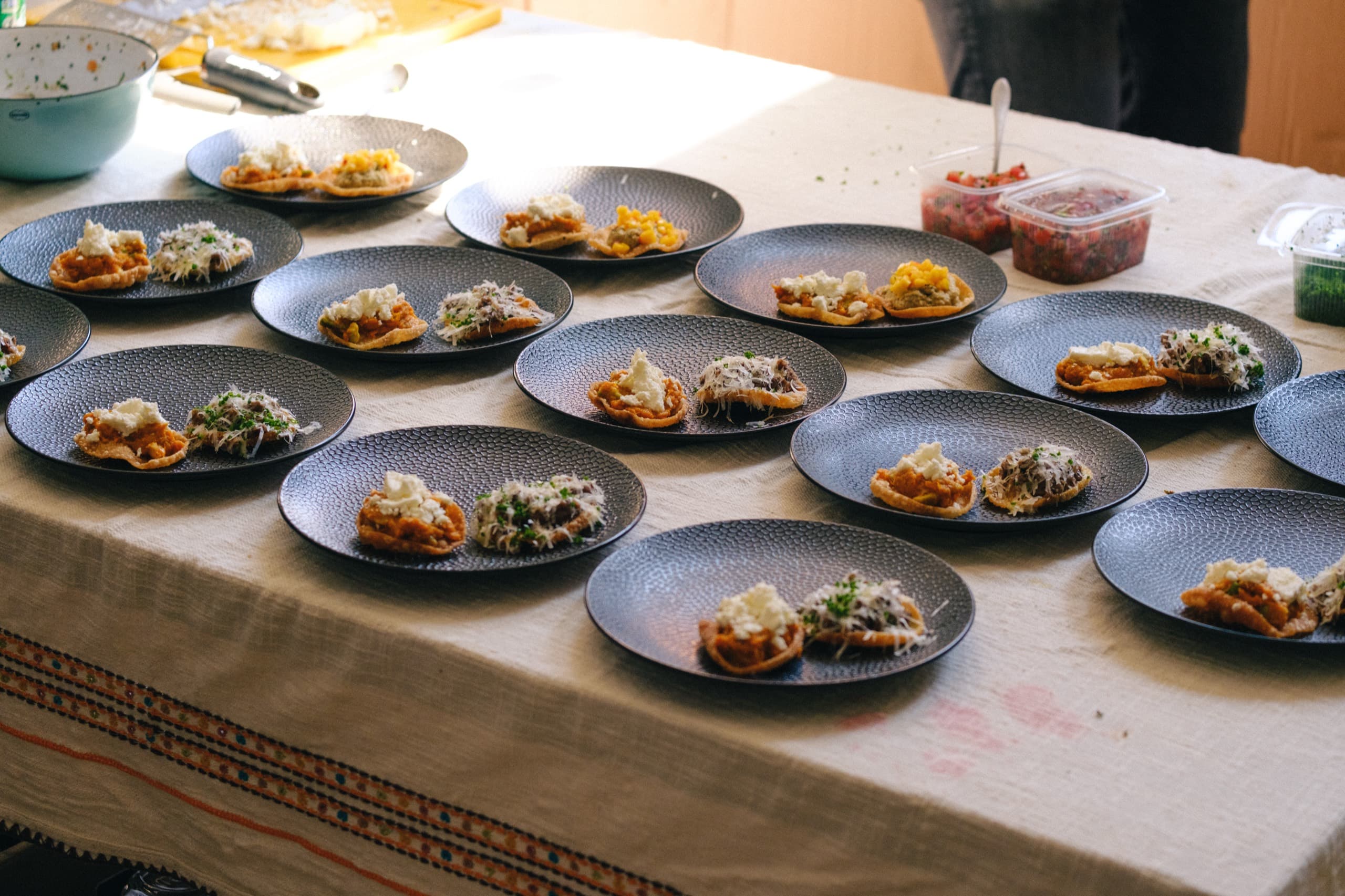
At a Walking Dinner that works naturally: the courses come past, and a guest with their own version of the same course does not stand out. If a group needs more than a variant here and there, Custom Catering is the route: the requirements then sit in the design of the menu rather than on top of it.
Frequently asked questions
Which allergens must information be given about?
Fourteen: gluten-containing cereals, crustaceans, eggs, fish, peanuts, soy, milk, tree nuts, celery, mustard, sesame seeds, sulphur dioxide and sulphites, lupin and molluscs. That duty covers non-prepacked food, and so catering.
Should I mention an allergy even if it affects one guest?
Yes, especially then. One guest with a nut allergy changes how a course is prepared, not just what goes on their plate. We agree every dietary requirement and allergy with you in advance.
When should I pass on dietary requirements?
With the enquiry, even if the list is not complete. Adding to it later is always fine; what you want to avoid is an allergy surfacing on the day itself, when there is no menu left to build it into.
Can you make a fully vegetarian or vegan menu?
We can. A fully vegetarian or vegan menu runs through Custom Catering: the requirement becomes the starting point of the menu rather than something lifted out of a set one.
- NVWA: over welke allergenen moet ik informatie geven retrieved 13 August 2026
- NVWA: allergenen bij onverpakte levensmiddelen retrieved 13 August 2026