Organising a Walking Dinner: complete guide
A Walking Dinner is a dinner of six to eight small courses, served while your guests stand, move around and talk. We cater them all year round. This is what we explain to a host before anything is settled: what the format is, what it asks of your space and your schedule, who arranges what, and the cases in which we would advise something else.
What is a Walking Dinner?
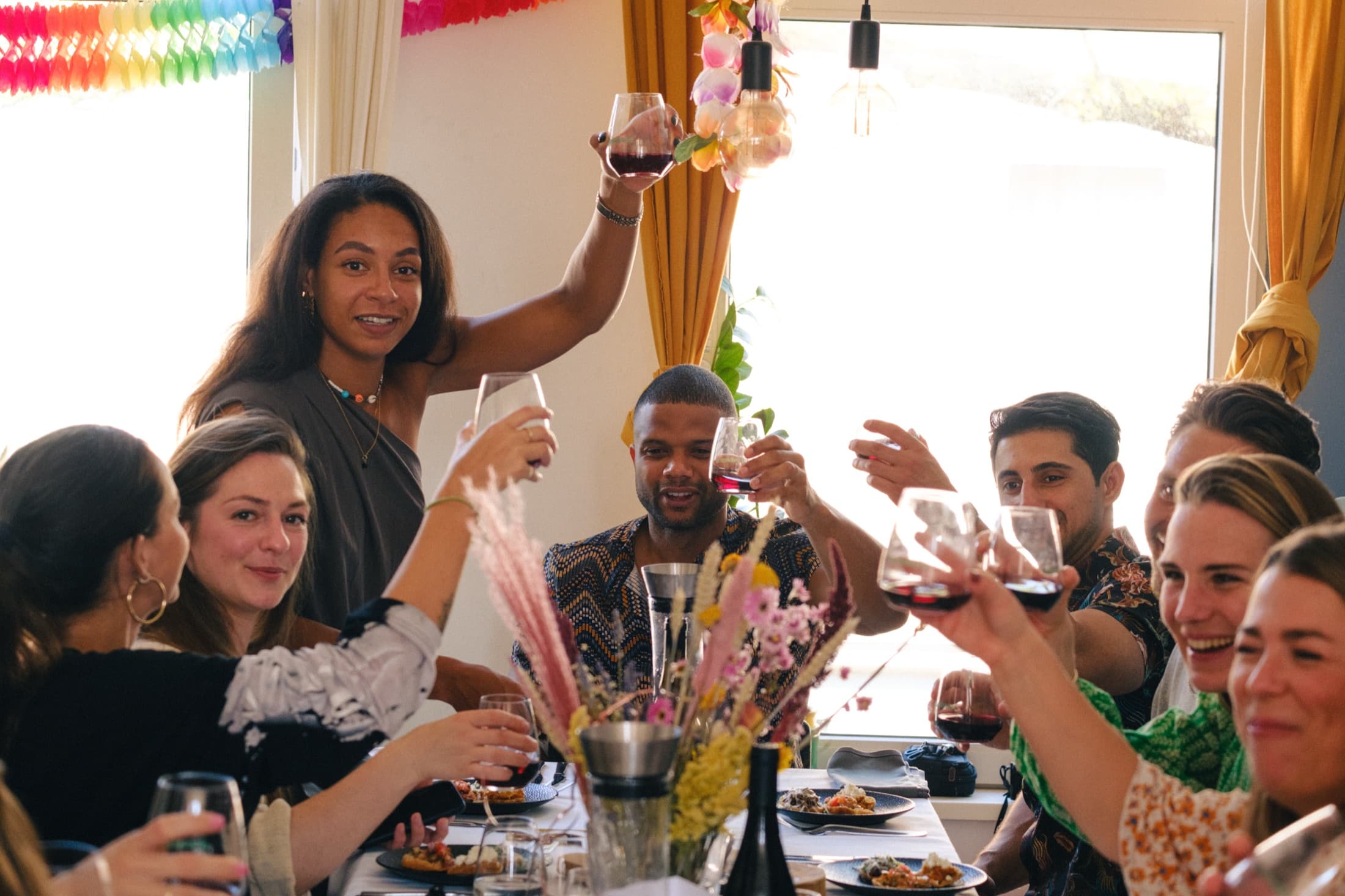
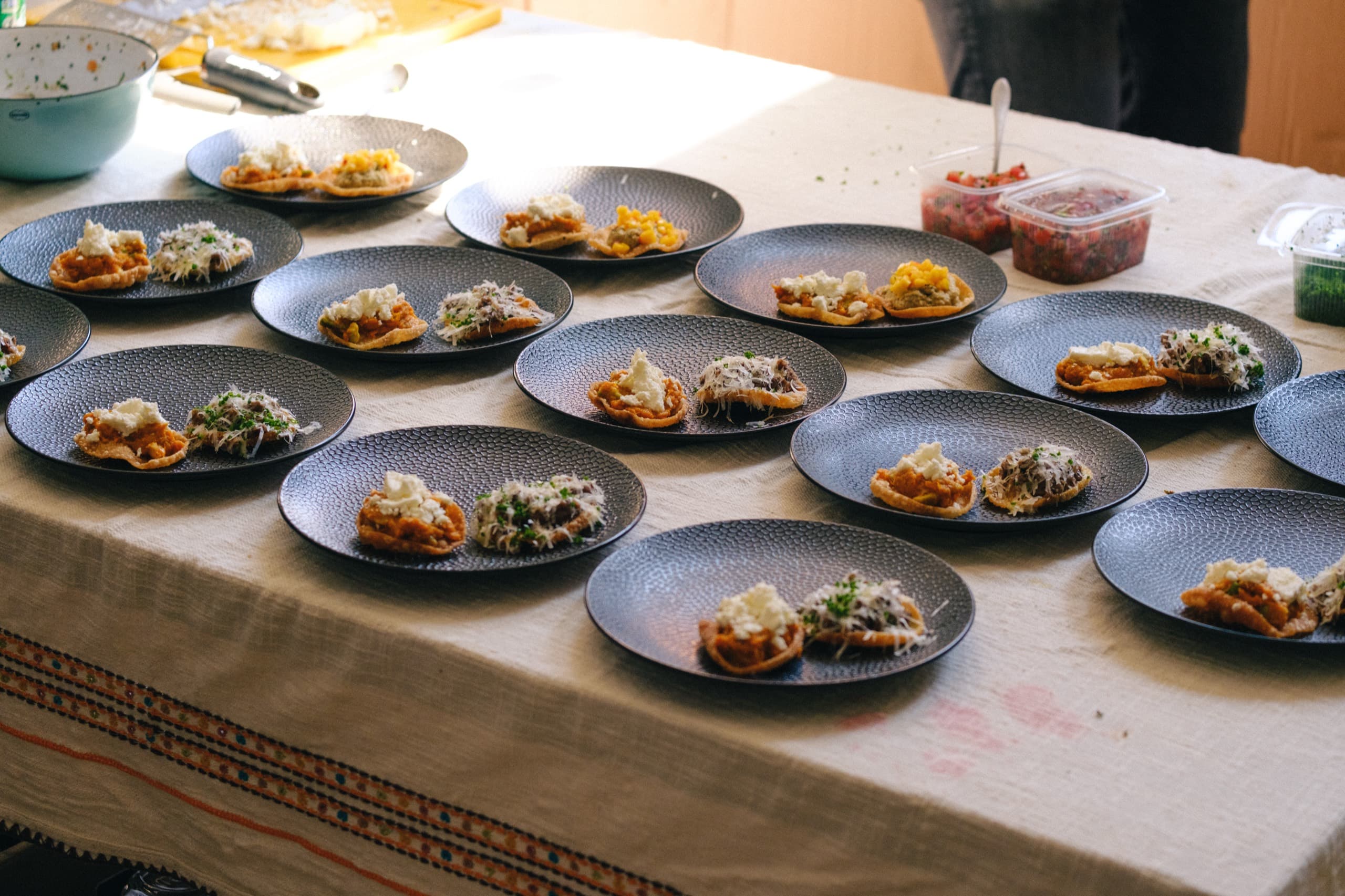
A Walking Dinner is a full dinner served in small courses to guests who are not seated at a table. Six to eight times a course comes past: starting cold, building to warm and substantial, finishing with dessert. Your guests stay where they are; the food moves.
The difference from drinks and canapés is the structure: bites are separate moments, a Walking Dinner is a menu with an order and an end. The difference from a buffet is direction: at a buffet the guests walk to the food, here the food comes to them. And the difference from a seated dinner is freedom of movement: nobody is stuck with the same four people all evening.
Who does the format work for?
It works best for groups who have mostly come together to talk to each other. A company party, an anniversary, a reception after a ceremony, a birthday with three generations mixing: wherever the conversation matters more than the seating plan, this format beats a seated dinner.
It also works when your room is smaller than your guest list. Without chairs, tables and aisles between them you keep floor space, which is exactly what a host with a beautiful but compact venue needs.
How much space do you need?
For a standing format, allow roughly 1 to 1.5 square metres per guest, against about 2 square metres per guest for a seated dinner. For a hundred guests that is the difference between roughly 125 and 200 square metres.
Treat those figures as a rule of thumb, not a standard; they vary by source and by room. More important than the floor area is the shape: a long narrow space jams at one point, while a space with two or three places to linger divides the group by itself. We look at that for every venue and say so when it will be tight.
Think about seating for anyone who cannot stand for two hours, too. A Walking Dinner does not mean there is no chair in the room; it means nobody has a fixed place.
How long does a Walking Dinner take?
Everyone has eaten within about two hours, without the evening stalling in between. That is the format's most important planning property: there is no half hour in which half the room queues while the other half waits.
For a programme that is easy to work with. Between two courses there is always a natural moment for a speech or a toast, and by then the attention is already at the front of the room. You fill a longer programme with the number of courses: six for an evening that has to keep moving, eight when the dinner is the main event.
When should you not do it?
Do not choose a Walking Dinner if a large share of your guests has limited mobility. The format assumes people can stand and move; for a group where that is not true for many, a seated dinner is kinder, and we would rather say so in advance than afterwards.
Do not choose it for a formal, ceremonial evening with long speeches and a fixed seating plan either. Then the form works against you: you are asking people to sit down and circulate at the same time.
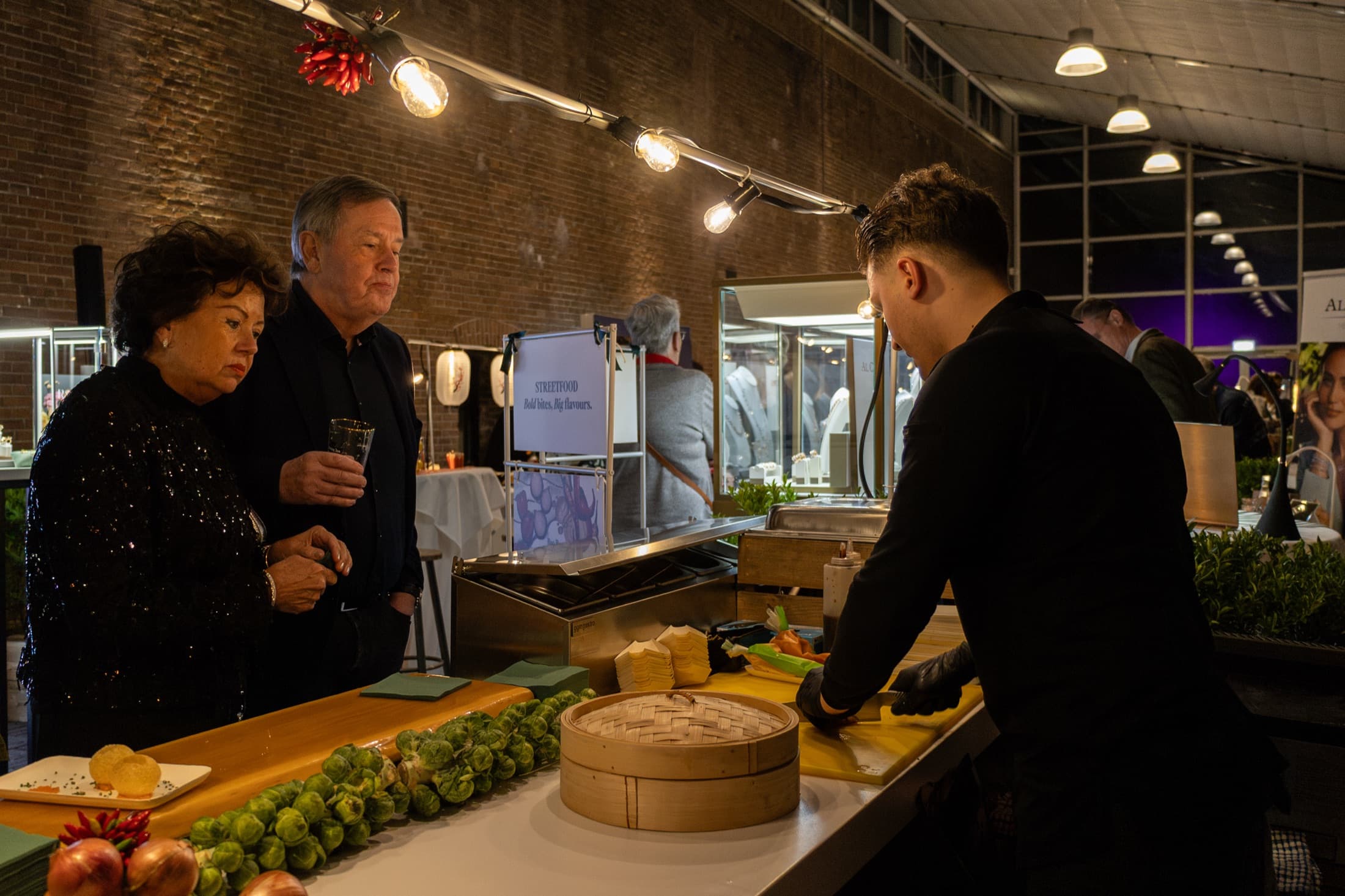
And if your event runs over a long stretch with guests coming and going, serving courses is awkward: you would be carrying them round a group that keeps changing. Foodstands are the answer to that.
What does the caterer arrange, and what do you?
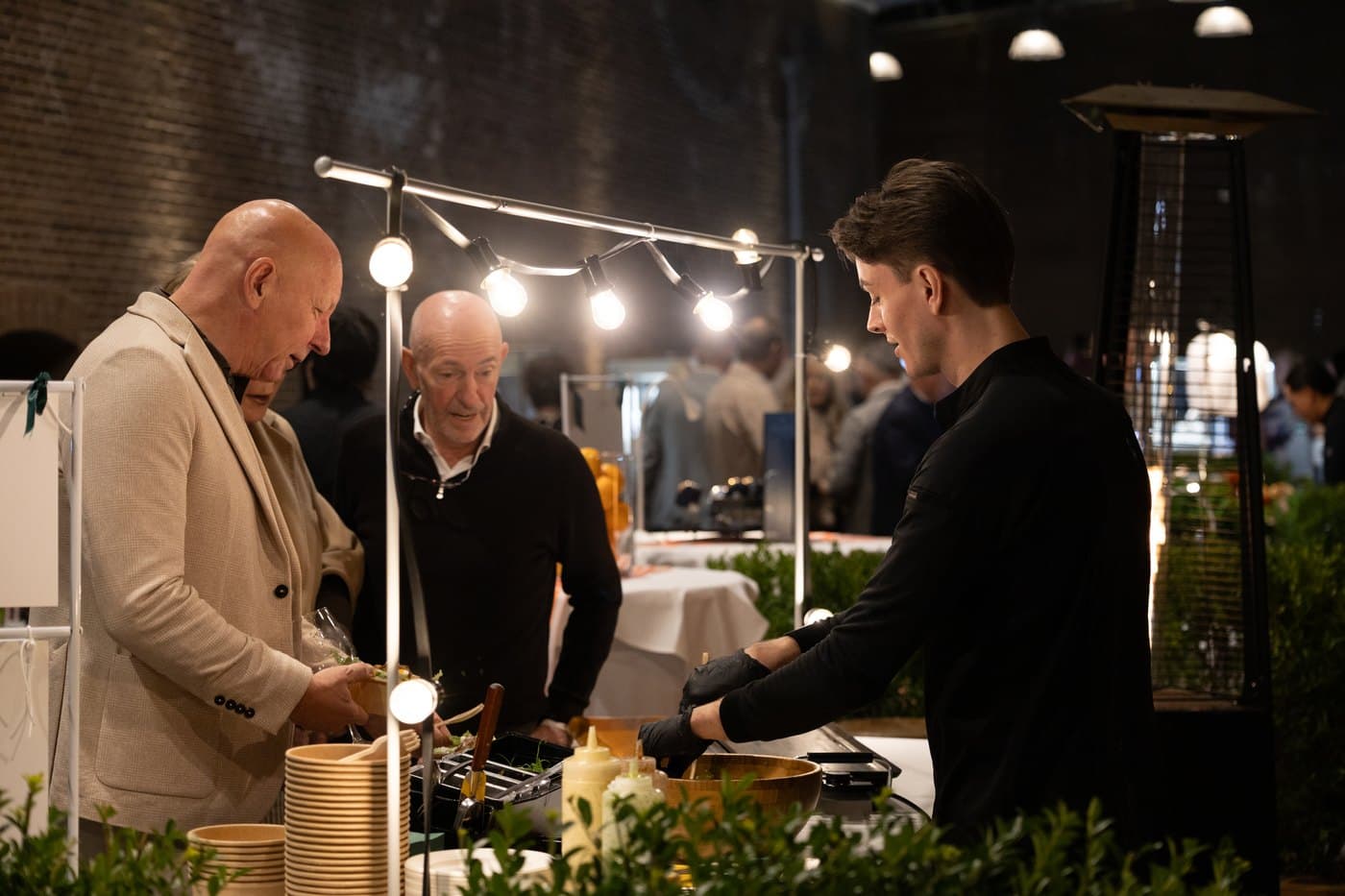
We arrive well before your guests, set up, cook on site, serve, clear and leave the venue clean. All of that sits inside the price per person, staff and tableware included: what you budget in advance is what the evening costs.
You arrange the venue and the programme, and you tell us in advance what we need to know: the number of guests, the layout of the room, the time the dinner should start, and every dietary requirement and allergy. That last one as early as possible, because it is the only factor that genuinely reshapes the menu.
From how many guests, and how is it priced?
We serve a Walking Dinner from 25 guests, throughout the country, out of Rotterdam. The price is per person and depends on the menu and the number of courses you choose.
The figures are on the Walking Dinner page, with a calculator where you enter your guest count and see where you land. We do not repeat them here: one place with prices is one place that is right.
Frequently asked questions
How many courses does a Walking Dinner have?
Six to eight, and you choose the length yourself. Both menus (Signature and Prestige) can be booked at six, seven or eight courses: six for an evening with a full programme, eight when the dinner is the main event.
How long will my guests be eating?
About two hours for the whole dinner. There is no waiting point at which the evening stalls, so a speech or a performance fits in without trouble.
Will a Walking Dinner fit in my venue?
A standing format is generally reckoned at about 1 to 1.5 square metres per guest; a seated dinner needs around 2. So the same room holds considerably more people at a Walking Dinner.
Can a Walking Dinner be held at my home?
Yes. We cook at your location: at home, at the office or at an event venue. We bring everything needed for it.
From how many guests do you serve a Walking Dinner?
From 25 guests. For smaller groups we are happy to put together a tailored proposal.
- Evenementorganiseren.nl: hoeveel personen per m² retrieved 13 August 2026